
Articles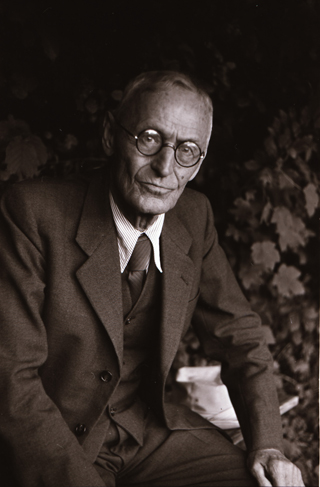
Siddhartha, Steppenwolf and Hermann Hesse's Question About Identity
By Vijayanti Margassery · October 5, 2026
Hermann Hesse was fourteen when he ran away from the seminary at Maulbronn. His parents were missionaries, and his life had more or less been decided for him before he was old enough to have a view on it. He spent the next several years in some distress, fought with his family, worked in a bookshop and eventually became a writer. Later, during the First World War, he spoke against the nationalism that had swept up most of German intellectual life, was called a traitor in the press, and in 1924 took Swiss citizenship. Twice, then, he walked out of an identity that other people considered his. It is not surprising that his novels keep coming back to the same question.
Siddhartha is the clearest case. He is born a Brahmin's son, gifted and admired, and he leaves home because the learning he has received does not feel like his own. He joins the wandering ascetics and leaves them too. He meets the Buddha, recognises him as genuinely enlightened, and still declines to become his follower. His reason is that enlightenment cannot be handed over through a teaching. Each person has to arrive at it through their own life.
What I find more interesting is what happens next. Siddhartha goes into the city and becomes, of all things, a merchant. He learns love from Kamala and business from Kamaswami. He grows rich, gambles, drinks and slowly becomes the kind of man he once looked down on. Years later he ends up sitting by a river, disgusted with himself, close to giving up. And yet Hesse does not treat the merchant years as a mistake. Siddhartha needed to live inside that identity fully in order to know, from the inside, that it was not him. The ferryman Vasudeva, who teaches him to listen to the river, does not give him a new doctrine. He gives him patience with the whole of his life, including the parts he is ashamed of.
There is something here that a lot of career advice misses. We tend to talk about identity as if the goal is to find the right one early and then protect it. Siddhartha suggests the opposite. Some identities have to be lived through and outgrown, and you only find out they were temporary by inhabiting them completely.
Harry Haller in Steppenwolf has a different problem. He is a middle aged intellectual who believes he is made of two natures. One is a cultured, respectable man who loves Mozart and Goethe. The other is a wolf from the steppes, lonely, contemptuous and wild. He lives in constant conflict between them and feels that neither side lets the other rest.
Then he is given a strange little pamphlet, the Treatise on the Steppenwolf, which tells him that this picture is far too simple. A person is not one self or two selves, it says, but many, perhaps hundreds. The division into man and wolf is a story Harry has told himself because it is easier to hold than the real complexity. By the end of the novel, in the Magic Theatre, he watches his personality being broken into pieces like chessmen and rearranged into new combinations. The point is not that he finds his true self. The point is that he loosens his grip on the single story he had been using to explain himself.
Psychology has been saying something similar for a while. Dan McAdams describes identity as a life story we keep composing and revising, a narrative rather than a fixed fact. Hazel Markus and Paula Nurius wrote about possible selves, the versions of ourselves we hope to become or fear becoming, and argued that these future selves shape behaviour as much as the present one does. Patricia Linville found that people whose sense of self rests on many distinct aspects tend to cope better when one of those aspects is threatened. A person whose whole identity is "I am a CEO" has much more to lose when the role ends than someone who is also a parent, a gardener, a student, a friend.
That is Harry's lesson in plain language. When we reduce ourselves to one or two labels, every threat to those labels feels like a threat to our existence.
This matters a great deal at work, because organisations are very good at giving people narrow identities and rewarding them for holding on. The expert gets promoted for being the expert. The operator gets praised for firefighting. The founder is celebrated for instinct and speed. Each of these identities is useful for a while, and each one can quietly harden. Herminia Ibarra's research on leadership transitions shows how often capable people get stuck at exactly this point. She calls it the authenticity paradox. They hold on to the version of themselves that made them successful, describe it as being authentic, and resist the experiments that the next role requires. Her work on career change found that people rarely think their way into a new identity. They act their way into it, trying on provisional selves before they are sure, much as Siddhartha tried on the merchant.
William Bridges pointed out that every real transition begins with an ending. Before something new can start, something old has to be let go of, and there is usually a confusing period in between where the old identity no longer fits and the new one has not formed. Most of us try to rush through that middle period or avoid it altogether. Siddhartha spent years in it. Harry Haller nearly did not survive it.
Robert Kegan's account of adult development helps explain why this is so hard. For much of our lives we are inside our identities and cannot see them, in the same way we cannot see the lens we are looking through. Growth happens when something we were identified with becomes something we can look at and question. Only then do we have a choice about it.
So when people tell me to be true to myself, I want to ask which self they mean. The one my family raised, the one my profession rewarded, the one that worked well fifteen years ago? Identity does real work for us. It gives coherence and belonging, and losing it can be frightening. But it can also become an old agreement with someone we used to be, and we keep honouring it long after it stopped serving us.
Hesse's characters do not find themselves in the way we usually mean that phrase. Siddhartha lets go of one self after another until he can listen. Harry learns that he was never just two things. Both of them become more themselves by holding their identities more loosely.
I would like to hear from people who have been through a transition like this. What did you have to stop being before you could become what came next?
Pic. Courtesy - Martinhess-fotoarchiv